

Introduction
Public libraries in the United States have undergone a major transformation in recent years, shifting from organizations primarily focused on informational provision to multi-purpose community learning hubs that respond to a wide range of social needs (Abbas & Koh, 2015; Vamanu et al., 2025). Historically centered on access to information recorded in print, public libraries have expanded their remit to facilitate access to information across formats and, increasingly, to deliver services that advance social equity and strengthen community resilience. This repositioning in so-called “disruptive times” needs strategic adaptation to the changing needs of diverse local populations (O’Connor, 2015).
Contemporary public libraries now provide an extensive suite of resources, including job search support, meeting and study spaces, meals for children, and connections to social and digital services. With nearly 9,000 public library systems supported by more than $12 billion in annual local and federal funding, libraries are frequently characterized as institutional infrastructure for social equity through their capacity to provide practical supports to marginalized groups (Vamanu et al., 2025). In this role, libraries help reduce gaps in access to essential services and mitigate the effects of structural barriers faced by underrepresented communities.
At the same time, public libraries increasingly operate in reform environments that frame public spending as an “investment” requiring justification through demonstrable benefits relative to cost (Afzal et al., 2025; Fitch & Warner, 1998). These expectations coincide with managerial restructuring that privileges performance measurement, efficiency analysis, and quasi-market accountability across public services, including libraries (Düren et al., 2017). Within library studies, this governance context has intensified demand for valuation work that can respond to fiscal scrutiny while recognising the plurality of library value, including private benefits, non-market welfare effects, and collective outcomes.
Beyond fiscal scrutiny, libraries also face a more basic challenge regarding institutional necessity in an environment where artificial intelligence, large language models, and conversational chatbots offer information access at near-zero marginal cost (Lo, 2025; Scoulas & Kim, 2025). For some policymakers and members of the public, the perceived abundance of digital knowledge raises questions about the rationale for ongoing public investment in physical library systems and professional services (Holt et al., 1996, 1999). However, claims that public libraries are redundant because generative AI makes information “free” are not well supported (Hanegan & Rosser, 2025). Recent evidence and public-discourse analyses continue to identify majority positive sentiment about library relevance—and willingness to pay (WTP) for library services—even in the AI era (Ayinde et al., 2025; Chemulwo & Sirorei, 2020; Jha, 2023; Rahmani, 2023; Verma & Gupta, 2022).
In response to these pressures, a substantial body of library value research has moved beyond simple output reporting towards outcome-oriented valuation and impact assessment, although methodological issues remain persistent. Economics-oriented scholarship increasingly treats libraries as mixed goods: some services resemble private, divisible consumption (for example, lending and digital access), whereas other benefits take the form of public goods, externalities, and place-based spillovers (Albergaria, 2024; Martorana & Rizzo, 2024). These features complicate valuation. Conventional welfare-economic accounts of “return” rely on individual utility, preferences, and consumer surplus, yet libraries are collectively funded, typically unpriced at the point of use, and valued by both users and non-users. In such contexts, WTP estimates can inform welfare claims, but they require careful interpretation because commonly used survey responses are sensitive to scenario framing, information cues, and respondents’ beliefs about what is being valued.
Recent contingent valuation (CV) and social valuation studies illustrate both the promise and the limits of stated-preference approaches for public libraries. Fujiwara et al. (2022), for example, estimate monetary values for maintaining public library services in England using a large CV design that includes non-users, supporting the argument that libraries generate welfare benefits beyond direct users and beyond lending. Similarly, Gómez-Zapata et al. (2023) apply CV to public libraries as cultural public goods and find positive stated values for maintaining libraries. At the same time, this literature also documents why valuation should not rely on a single survey-based metric when the goal is to justify public investment, guide system redesign, or support resource reallocation.
The literature suggests that libraries require valuation frameworks that match their mixed-good character, encompassing divisible services, non-market benefits, and community-level spillovers (Albergaria, 2024; Martorana & Rizzo, 2024; Sørensen, 2021). Reform-era accountability also places a premium on triangulation: valuation designs that draw on more than one method family, with explicit attention to double counting and to the distinct value channels each method can legitimately measure (De Leon, 2021; Gómez-Zapata & del Barrio-Tellado, 2023; Liu et al., 2023).
De Leon (2021) applies SROI to a public library case and reports a positive social value ratio, showing how SROI can translate less tangible benefits into an accountability format compatible with cost–benefit reasoning. Gómez-Zapata and del Barrio-Tellado (2023) extend this logic in a cultural heritage framing by combining SROI and contingent valuation to estimate social impact and justify public investment in a public library system. These studies show that ROI-style arguments can be developed from multiple evidence streams such as direct observation, stakeholder outcomes, and monetary proxies, rather than depending solely on willingness-to-pay surveys.
Building on this foundation, this article proposes an integrated approach to measuring return on investment (ROI) in public libraries that combines market-analogue valuation for services with defensible substitutes, CV for non-market welfare components (interpreted as welfare indicators rather than literal “prices”), and social and economic impact components using SROI logic and outcome evidence where appropriate. The aim is to develop and demonstrate a valuation strategy that is credible for contemporary reform and restructuring decisions while remaining consistent with welfare-economic foundations and with the empirical realities of how library investments generate benefits.
Literature Review
Welfare economics frames the value of a public library as the change in social welfare generated by the service relative to a counterfactual, typically expressed through changes in individual utility and monetized, using WTP or willingness to accept (WTA) measures (Freeman III et al., 2014; Hanemann, 1994; Mitchell & Carson, 1989). In this framework, libraries matter because they generate consumer surplus: users may receive benefits that exceed what they pay (often zero at the point of use), and accounting costs cannot be treated as a proxy for welfare (Aabø, 2005; Kingma, 2001). This is the conceptual basis for valuation approaches that aim to recover the welfare-consistent value of access to collections, spaces, learning opportunities, and information services where market prices are missing or heavily distorted.
A key welfare-economic perspective for library valuation is the distinction between use and non-use values. Use value arises from direct consumption (e.g., loans, programme attendance, reference services), whereas non-use value includes “option” value (keeping access available for uncertain future needs) and altruistic value such as valuing others’ access, including community-wide benefits (Aabø & Strand, 2004; Krutilla, 1967; Weisbrod, 1964). Aabø & Strand (2004), for example, show that non-use motivations can be material in stated valuations, and user-only methods are likely to understate total economic value. These non-use concepts are not library-specific: they are standard components of total economic value in non-market valuation, especially for goods tied to public provision and characterized by interdependent preferences (Freeman III et al., 2014; Kotch, 2007).
Welfare economics also explains why conventional pricing assumptions break down for libraries (Indiana Business Research Center, 2007). Libraries have characteristics associated with positive externalities, equity-oriented access, and benefits that are partially non-rival and difficult to price, therefore market prices (if constructed at all) are unlikely to equal marginal social value. This matters because policy audiences often seek “value-for-money” evidence (Levin et al., 2006), yet the absence of market-clearing prices makes it necessary to adopt valuation strategies that are theory-consistent even when administratively unfamiliar (Aabø, 2005; Kingma, 2001).
Recent scholarship strengthens these foundations by shifting from purely stated valuation to causal identification of impacts from library investment. For example, Gilpin’s work uses large-scale administrative data and quasi-experimental designs to estimate the effects of capital investment in public libraries on usage outcomes and related community indicators (libraries as local amenities with welfare benefits) and measurable impacts relevant to public finance debates (Gilpin et al., 2021, 2024).
These welfare foundations motivate, but do not resolve, ROI measurement (Kelly et al, 2012). Translating welfare-consistent value into a ratio for budget decisions needs choices about benefit categories (direct use, non-use, spillovers), monetization methods, counterfactuals, and communication standards (Library Council of New South Wales, 2008). This is where the literature typically transitions into market-equivalent and ROI-oriented approaches (Aabø, 2009; Kingma, 2001).
Market-equivalent models estimate library value by pricing services as if they were purchased in a market, commonly through replacement cost, market analogues, or avoided cost calculations (Ellis, 1994; Ko et al., 2012; Texas State Library and Archives Commission, 2012). In practice, this often involves valuing loans at the price of purchasing (new or used), valuing digital access via subscription proxies, or valuing reference/information help via commercial equivalents (Morris et al., 2001; Sumsion et al., 2002). These methods are popular in practice because they can be computed from routine library statistics, making them legible to policymakers and budget officers (Aabø, 2009; Kingma, 2001).
However, market-equivalent methods often approximate avoided expenditure rather than consumer surplus, and therefore do not directly measure welfare change (Freeman III et al., 2014; Kingma, 2001). In addition, they generally omit non-use values and spillovers that lack clean market proxies, including altruistic and option components demonstrated in library valuation work (Aabø & Strand, 2004; Lee & Chung, 2012). Also, results can be highly sensitive to discounting conventions that may be only loosely anchored to local behavioral evidence (Aabø, 2009; Morris et al., 2001). Therefore, a recurring technical issue is discounting: analysts typically apply (arbitrary) discounts to account for depreciation of used materials, the fact that not every loan substitutes for a purchase, and quality differences between library access and market alternatives (Morris et al., 2001; Sumsion et al., 2002), while this method still often faces the issue of sensitivity (Kamer, 2005).
CV has been the dominant stated-preference approach for estimating the non-market value of public libraries because it can, in theory, measure consumer surplus and non-use values that are not priced in markets (Aabø, 2005; Mitchell & Carson, 1989). In library settings, CV is typically implemented through WTP survey questions that ask residents how much they would be willing to pay (often via taxes, fees, or donations) to maintain or expand library services (Griffiths et al., 2007). The methodological appeal is straightforward: if libraries generate utility beyond what is observable in transactions, WTP may be used for approximating that utility in monetary terms, enabling cost–benefit comparisons without necessarily a heavy computational burden (Aabø, 2005;Chung, 2008).
Over time, CV practice has moved away from simple open-ended WTP prompts towards formats designed to reduce well-known sources of bias (Hájek & Stejskal, 2015; Noonan, 2003). This includes the use of dichotomous choice questions, follow-up certainty scales, carefully constructed scenarios, and split-sample designs to test sensitivity to framing and information (Ajzen et al., 1996; Arrow et al., 1993; National Library of New Zealand, 2002). In the library field, Chung (2008) is often cited for explicitly adapting CV design features to public library contexts, such as attempts to minimize information and response biases. Related work has also applied CV to estimate public value in national and municipal libraries, showing how WTP varies by proximity, usage patterns, and perceived service bundles (Hider, 2008; Kwak & Yoo, 2012).
Even with improved WTP survey designs, several limitations remain persistent and are especially salient for libraries. Sampling bias and non-response bias can be substantial when surveys rely on library users/patrons, convenience samples, or low-response community surveys, which may overstate average WTP if respondents are systematically more supportive of libraries than non-respondents (Arrow et al., 1993; Kim, 2011). Information bias is difficult to eliminate because WTP is sensitive to what respondents are told about library services, costs, and counterfactuals; more detailed information can either increase WTP (through salience) or decrease it (through skepticism or perceived substitution) (Ajzen et al., 1996; Chung, 2008). Also, protest responses are surprisingly common in public service valuation: some respondents refuse the premise of monetizing a civic service or reject the payment vehicle (e.g., “libraries should be fully funded already”), creating modelling challenges (Arrow et al., 1993; Kim, 2011). Framing effects (including scope insensitivity and embedding) are also well documented in CV literature generally and have been repeatedly flagged as concerns in library valuation studies because respondents may treat “the library” as a symbolic public good rather than valuing marginal service changes (Arrow et al., 1993; Kim, 2011; Sørensen, 2021).
A key interpretive point for library scholarship is that CV tends to measure perceived value expressed as behavioral intention under a constructed scenario, not necessarily the economic value actually received through realized use (Ajzen, 2004; Ajzen & Driver, 1992). This distinction matters for ROI debates: WTP responses may actually mean civic identity, trust in local government, or attitudes towards taxation as much as service-specific surplus, especially where non-use motives (option values and altruistic intention) are prominent (Aabø, 2005; Aabø & Strand, 2004; Sørensen, 2021). Therefore, CV evidence is best read as one component of a valuation portfolio, rather than a stand-alone measure of “true” economic return (Pung, 2004).
SROI is another valuation strand that shifts attention from WTP to outcome-based accounts of social value (University of North Carolina at Charlotte Urban Institute, 2010). SROI operationalizes a theory-of-change logic: identify outcomes linked to library activities, assign financial proxies to those outcomes, and compare monetized benefits to inputs (Nicholls et al., 2012). In the library domain, SROI has been used to translate public value in ways that are readily understood by funders and stakeholders, where outcomes (e.g., employability, wellbeing, learning, and social inclusion) are central to the library’s mission and where conventional market analogues are weak (De Leon, 2021; Gómez-Zapata et al., 2023).
SROI’s main strengths are practical rather than econometric. SROI creates an explicit results chain (activities to outputs to outcomes), encourages stakeholder engagement to define what “value” means locally, and provides a narrative-friendly metric that can support advocacy (Nicholls et al., 2012; De Leon, 2021). For libraries facing budget scrutiny, these features can be strategically useful because they make visible benefits that do not appear in borrowing counts or other usage metrics (Gómez-Zapata et al., 2023; Sørensen, 2021).
However, SROI is also highly sensitive to assumptions and therefore less comparable across jurisdictions or over time. Results can vary depending on proxy selection, attribution and deadweight assumptions, treatment of displacement, and decisions about discounting and time horizons (Nicholls et al., 2012). The valuation literature also notes concerns about whether SROI ratios risk precision where uncertainty is substantial, especially when proxies are borrowed from unrelated/less-related contexts or when outcomes are difficult to causally attribute to library inputs (Arvidson et al., 2013; Sørensen, 2021). For library valuation, SROI requires analytical discipline and transparency about counterfactuals if it is to inform resource-allocation decisions rather than advocacy alone (Arvidson et al., 2013; Nicholls et al., 2012).
A growing body of recent work treats libraries as multi-output producers and asks whether they operate efficiently given input costs and output bundles. Cost-function research in library economics provided foundations for modelling production and cost structures (Hammond, 1999), and more recent work extends this logic with richer multi-output measures and larger datasets. A recent example is Liu et al. (2023), who apply a multi-output cost-function approach to a large sample of US public libraries and directly evaluate scale economies and efficiency claims. Their argument is that prior efficiency research often relied on single-output proxies (especially circulation), which can misrepresent modern libraries’ programme and service portfolios.
Methodology
Market-analogue approaches have been used widely in practitioner and marketing reports because they translate services into observable prices and can appear more “objective” to stakeholders (NorthStar Economics, 2008; Steffen et al., 2009). By contrast, CV has been more common in academic work because it can, in principle, show consumer surplus and non-use values that are not often measured in market transactions (Aabø, 2005; Chung, 2008; Kingma, 2001). However, the two approaches are not equivalent and they measure different value channels. Kim’s (2011) review illustrates the extent of methodological separation: among 15 valuation studies reviewed, most used a single method (market value only or CV only), and studies that used both typically applied them in parallel for comparison rather than combining them into a single valuation logic.
Recent synthesis work presents the view that valuation methods are complements rather than substitutes. Market-analogue approaches are transparent but tend to omit consumer surplus, non-use value, and spillovers (Aabø, 2009; Kingma, 2001). CV/WTP approaches can measure non-market benefits but remain sensitive to survey design, sampling and non-response bias, protest responses, and framing effects (Ajzen, 2004; Ajzen et al., 1996; Chung, 2008; Kim, 2011). SROI approaches add an outcome and accountability logic and are often persuasive in communication, but comparability across settings is limited and results are sensitive to proxy choices and counterfactual assumptions (Arvidson et al., 2013; De Leon, 2021; Nicholls et al., 2012). Systematic reviews of library valuation research therefore continue to point to fragmentation, uneven handling of non-use value, and limited accumulation of comparable evidence across contexts (Aabø, 2009; Kim, 2011; Sørensen, 2021).
Single-method studies risk systematic underestimation when they focus narrowly on replacement cost or market analogues, and they risk overstatement when WTP responses embed symbolic support (rather than marginal service valuation) or when SROI modelling adopts optimistic proxies without disciplined treatment of deadweight, displacement, and attribution (Aabø, 2009; Arvidson et al., 2013; Kim, 2011). An integrated design is therefore justified not as a simple “averaging” of methods, but as an allocation of measurement tasks to the method best suited to each value channel.
This study proposes an integrated ROI model that combines market-analogue valuation, CV, and economic impact analysis, with explicit rules to reduce double counting and to clarify what each component can legitimately measure.
In terms of direct user benefits with credible market substitutes, for services with defensible market equivalents (for example, purchasable media, subscription-based digital content, room hire, or paid training programs), we use market prices of equivalent alternatives to approximate the value of direct benefits to users. Where relevant, prices are adjusted to consider realistic substitution and depreciation (for example, used-market pricing or conservative discounting), recognizing that the relevant comparator is not always a new-item retail price (Kingma, 2001; Morris et al., 2001; Sumsion et al., 2002).
As to diffused social benefits and non-market value, for benefits that lack market prices or where market analogues are not credible (for example, option value, altruistic value, existence-related support, and other non-use components), we use a CV design to estimate WTP. The CV component is treated as a welfare indicator that captures perceived valuation under a defined scenario, rather than as a literal “price” for library services (Barron et al., 2005). Design features should therefore address known CV vulnerabilities, including information bias and framing effects (Ajzen et al., 1996; Chung, 2008), protest responses and hypothetical bias (Ajzen, 2004; Kim, 2011), and sample representativeness (Arrow et al., 1993).
Regarding diffused economic impacts of library operations, to estimate local economic impacts, we apply standard economic impact logic focused on net impacts and leakage, rather than counting gross payroll and gross procurement spending as “returns.” The intent is to measure plausible additional local activity attributable to library operations under a defensible counterfactual, using conservative assumptions about retention and multiplier effects (Wilson, 2013). This component is positioned as an economic impact estimate, analytically distinct from user-level valuation and non-use welfare estimates.
Table 1 summarizes the comparative strengths and limitations of the market value approach, the CV approach, and the proposed integrated approach, and clarifies why the integrated approach is more demanding but also more robust for decision contexts that require triangulation (Aabø, 2009; Sørensen, 2021).Fig. 1 presents the logic model for how the integrated approach combines market pricing, survey-based surplus estimation, and economic impact analysis into a single ROI calculation while keeping the components conceptually separable.
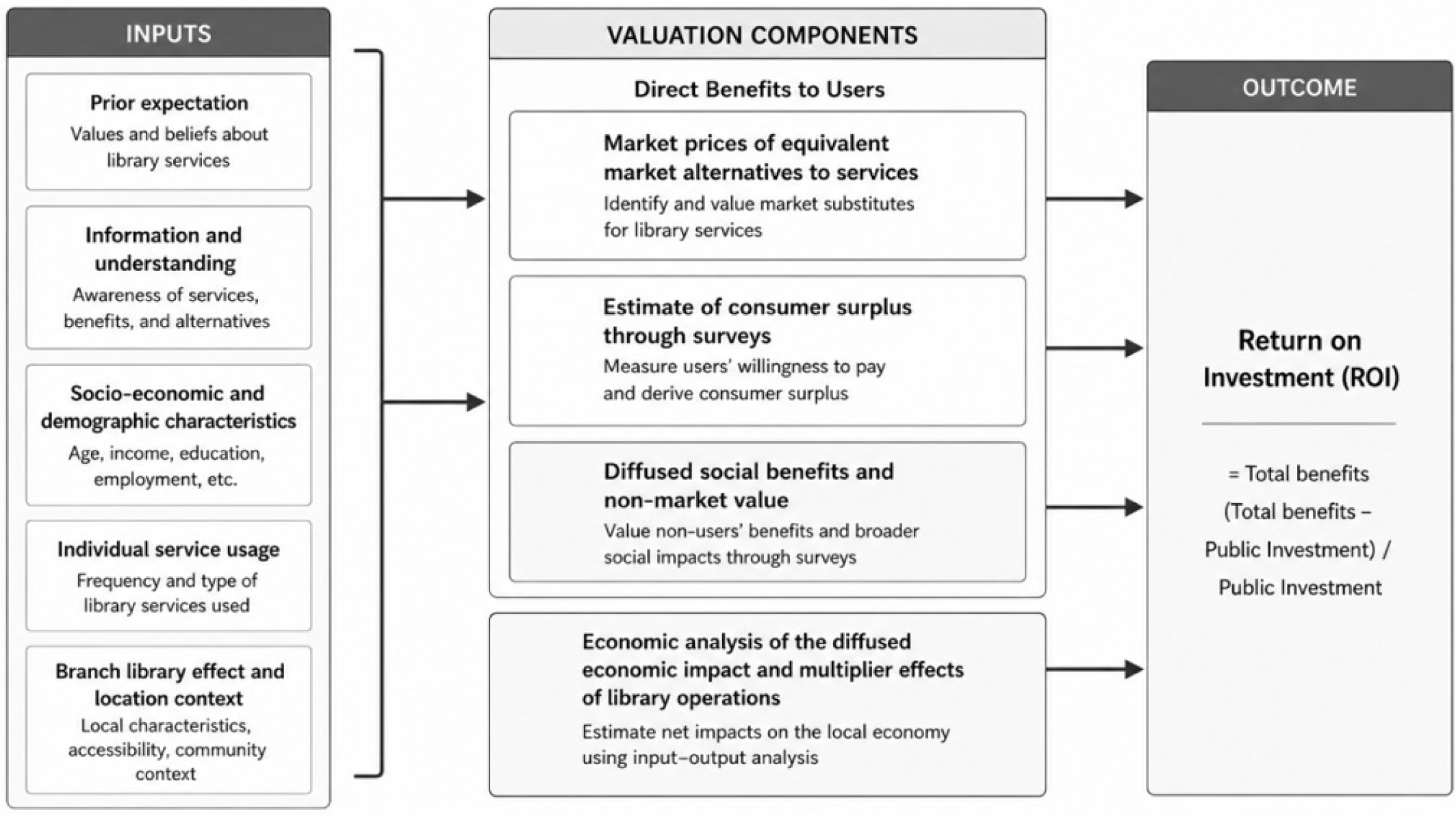
Fig. 1 shows the methodologies of our proposed integrated approach. Also, we emphasize the need to use surveys to understand the underlying factors that influence the perceived value of library services. Past studies have found that perception of public program performance and the value of public services are not primarily driven by actual service outputs or outcomes. Prior expectations, personal experiences and beliefs, and the socio-economic and demographic background of residents significantly influence their perceptions of government effectiveness and the perceived value of government programs (Ho & Cho, 2015; James, 2011; Van Ryzin, 2004). These are consistent with the arguments of some institutionalists who suggest that individual utility is not purely an economic function. It is also framed and embedded in the normative institutions and values of society (Friedland & Alford, 1991).
Case Context: Johnson County Library
We apply the proposed integrated approach to evaluate the ROI of Johnson County Library (JCL) in Kansas, located within the Kansas City metropolitan area. Johnson County lies on the Kansas side of the metropolitan region and includes a mix of mature inner-ring suburbs and rapidly growing outer suburban municipalities. This spatial configuration is analytically relevant because library access, usage intensity, and perceived value are affected by travel distance, branch proximity, and neighborhood-level socioeconomic composition.
In demographic terms, Johnson County is one of the most affluent and highly educated counties in the Midwest. Recent American Community Survey estimates show a median household income exceeding USD 100,000 and a majority of adults holding at least a bachelor’s degree. These characteristics are important for interpretation: high private purchasing capacity may reduce reliance on libraries for market-substitutable goods, while simultaneously increasing demand for non-market benefits such as learning spaces, digital resources, and community amenities. Accordingly, both use patterns and WTP responses should be interpreted within this socioeconomic and spatial context rather than as direct reflections of service quality alone.
JCL operates a decentralized branch-based system comprising 14 physical library locations distributed across the county, including large regional facilities (such as the Central Resource Library in Overland Park) and smaller community branches serving local catchment areas. The geographic dispersion of branches is a long-standing county policy of spatial equity and local access rather than a single centralized model. From a valuation perspective, this branch structure affects both direct use (for example, circulation and program attendance) and non-use value, as residents may value the “option” of nearby access even when they are not frequent users.
The institutional history of JCL is also relevant for understanding contemporary perceptions of value. The system originated in the early 1950s through volunteer-run and community-supported libraries operating in non-traditional spaces, including schools, private homes, and mobile bookmobiles. Formal county-level public funding began in the mid-twentieth century, gradually replacing volunteer provision and embedding the library within Johnson County’s public service infrastructure. Over subsequent decades, JCL expanded in parallel with suburban population growth, shifting from a collection-centered model to a multi-service public institution offering educational programs, digital access, meeting spaces, and community services. Long-standing public provision and community involvement contribute to institutional legitimacy, which may influence stated valuations and support for public funding independent of current service consumption. In addition, incremental expansion over time has produced a heterogeneous service portfolio and physical infrastructure, complicating valuation approaches that rely on a single output measure such as circulation.
This case is selected not as a statistically representative example, but as an analytically informative setting in which multiple value channels are observable. The combination of high socioeconomic capacity, diversified service provision, and established institutional legitimacy makes Johnson County Library a useful case for showing how different valuation methods interact.
Results: Implantation of the Proposed Valuation Project
The market value estimation rules by service category are specified in Table 2. The market-equivalent component prices library services using observed prices for close market substitutes and then applies those unit prices to observed service volumes. This component estimates the replacement value of divisible services for which credible private-market comparators exist.
For circulated books, the valuation uses a stratified sample of used-book prices that is consistent with the distribution of circulation frequency. The mean used-book price (inclusive of shipping) is multiplied by the annual circulation volume to obtain the total value for book borrowing. The same procedure is applied to multimedia items (CDs, DVDs, and audiobooks). E-books are valued by applying a (market-rate of) 70% discount to the used-book price benchmark to approximate the average price differential between Kindle titles and print materials, and then multiplying the discounted unit price by e-book circulation. Music and video downloads are valued using prevailing per-title or per-track download prices from commercial providers.
Periodicals are valued using subscription-fee benchmarks. For print newspapers and magazines, the method compiles subscription fees and then scales them to usage volume using the patron survey estimate of the proportion of visitors who browse newspapers or magazines at least monthly. For online newspapers and magazines, the method applies online subscription fees to the volume of digital check-outs.
Reference services are valued using a composite method intended to measure the major cost-avoiding functions of reference support and information access. The calculation includes: staff time for high-level reference questions, valued as the reference librarian hourly rate multiplied by the hours devoted to these interactions; academic journal access cost multiplied by the number of article accesses via ProQuest; and (c) online reference-platform access valued using subscription-fee equivalents, calculated as the average subscription fee multiplied by the number of log-on sessions (one-time single log-on charges are excluded).
Public computer use is valued using local rental fees for a computer equipped with standard office software. The rental fee is converted to an hourly rate by assuming availability for 12 hours per day and 7 days per week, then multiplied by observed usage hours. This assumption intentionally adopts a low/conservative hourly value and does not substitute higher commercial per-hour charges that would yield substantially larger valuations. WiFi is valued by applying an hourly cost of USD 0.35 to estimated WiFi usage hours. Meeting rooms are valued using hotel meeting-room rental rates, converted to a per-minute charge by room-size category and multiplied by the recorded minutes of meeting-room use. Library programs are valued using fees for comparable programs offered by non-profit providers (e.g., YMCA and parks and recreation), multiplied by the number of program participants. Volunteer labor is monetized as avoided staffing cost, calculated as total volunteer hours multiplied by the average hourly pay of a librarian. Aggregating across categories yields a market-equivalent estimate of direct user benefits of USD 74,563,235.
Table 3 shows that circulated materials constitute the largest share of direct benefits (USD 65,055,562). Additional contributions come from periodicals and database use (USD 3,425,061), programs (USD 2,674,489), meeting-room use (USD 2,240,135), and smaller components attributed to volunteering, reference services, and computer/WiFi use.
Then the model also estimates the net local economic effects of library operations by treating payroll and procurement as potential sources of additional local economic activity only to the extent that they present spending that would not otherwise occur within the county under a plausible counterfactual. The analytical issue is that gross expenditures are not equivalent to benefits: if employees would remain in the county and obtain comparable employment locally, or if supplier spending would have been directed to local firms regardless, then attributing the full payroll or full operating budget to the library as “impact” amounts to double counting. The procedure therefore imposes explicit leakage and counterfactual adjustments before any multiplier logic is applied, and Table 4 specifies the underlying estimation strategy.
The payroll channel begins with library payroll records to establish total compensation and average pay by job category. The analysis then uses an anonymous staff survey of more than 200 employees to estimate how much of that payroll constitutes net local economic activity. The survey elicits employees’ likely residential and employment responses under job elimination, including whether they would remain in the county and whether they would seek or obtain employment outside the county. The net local payroll effect is restricted to the share of compensation associated with employees who would leave the county if the library positions did not exist; compensation associated with employees expected to remain in the county is excluded because it is likely to be replaced by other local employment income rather than constituting additional county-level economic activity. In this design, the staff survey functions as a counterfactual screen that converts payroll from a gross accounting figure into an estimate of net local income injection.
The procurement channel uses the operating budget for contractual services and applies an explicit local-retention adjustment to consider vendor leakage. Rather than assuming that all contractual spending stimulates the local economy, the method assumes that a fixed share of relevant vendor and supplier spending remains within the county. The analysis adopts an 80% retention assumption (from the literature) for contractual services purchased from local vendors and suppliers, treating the remaining share as leakage. This approach again separates gross spending from plausible local impact by limiting the procurement effect to locally retained expenditure.
Multiplier effects are then estimated and only after these net-local adjustments. The multiplier calculation is anchored in two restrictive assumptions: an 80% marginal propensity to consume, used as a benchmark for the share of income that is spent rather than saved, and a 25% local retention rate for induced consumption, showing that only a limited portion of additional household spending is expected to circulate locally in ways that support additional local production. Combined, these assumptions imply an overall multiplier of 1.25, meaning that indirect and induced effects add approximately one quarter of the direct net local effect. This method avoids applying standard multipliers mechanically to the library’s full budget, and instead limits multiplier amplification to those portions of payroll and procurement that have already been screened for net local relevance.
Applying these steps yields an estimate of approximately $14.8 million in direct and multiplier economic benefits attributable to library operations. The value of this estimate is not its magnitude in isolation, but its interpretive discipline: it treats local economic effects as conditional on counterfactual residence and employment responses and on leakage from vendor markets, and it uses a deliberately low multiplier consistent with those leakage assumptions.
The WTP survey component estimates diffused social benefits using stated-preference evidence from the patron survey. This component is intended to capture value that is not directly tied to individual service consumption, including support for universal access, “option” value, and altruistic considerations. To separate these channels, respondents were asked to report both their WTP for their own household’s use of library services and an additional amount they would be willing to pay so that other county residents could access services without fees.
Table 5 reports the distribution of patrons’ stated WTP, distinguishing between the amounts respondents were willing to pay for their own household’s benefits and those they were willing to pay to support access for others. The distribution shows substantial variation across payment categories and a clear divergence between private-use valuation and valuation of access for others.
For WTP for own benefits, responses are concentrated in the lower-to-middle payment ranges. The largest number of respondents selected amounts between $5.00 and $5.99, followed by the $6.00–$9.99 category. A non-trivial share of respondents also reported zero WTP, showing that a sizeable portion of patrons did not assign a positive monetary value to their own use under the stated scenario. At the upper end of the distribution, relatively few respondents selected amounts above $20, suggesting that high personal valuations are uncommon and that the distribution is strongly right-skewed.
The distribution for WTP for others’ access differs. Zero WTP is the modal response in this column, with substantially more respondents reporting no willingness to contribute for others than for their own household use. Among positive responses, the distribution shifts toward smaller monetary amounts, particularly in the $0.01–$1.00 and $1.01–$2.99 categories. While some respondents report moderate contributions in the $5.00–$9.99 range, the frequency of higher payment categories declines sharply relative to the own-benefit column. Very few respondents indicate WTP for large amounts for others’ access, and the highest payment categories are sparsely populated.
Comparing the two columns shows that respondents are systematically more willing to assign positive monetary values to their own benefits than to the benefits accruing to others. Positive WTP is more prevalent and extends further into higher payment categories for own use, whereas support for others’ access is characterized by a higher incidence of zero responses and a stronger concentration at minimal payment levels. The ordering of categories by frequency also differs between the two measures, and respondents differentiate between private benefit and collective access when forming valuation judgements.
Across respondents, 72 percent reported a positive WTP for their own household’s use. The distribution of responses is right-skewed, with a median implied value of USD 59.50 per person per year. When extrapolated mechanically to the service population, this yields a contingent-valuation-only aggregate estimate of USD 18,354,160. This estimate is reported as a benchmark rather than as a preferred ROI measure, because the figures show that stated valuations vary systematically across population subgroups rather than presenting a uniform assessment of service value.
The figures reporting WTP distributions provide direct evidence of this heterogeneity. Fig. 2 show WTP for own benefits and for others’ access, respectively, stratified by household income. In both figures, the relationship between income and stated valuation seems monotonic: respondents in higher income brackets are progressively more likely to select higher WTP categories. The separation across income groups is modest at the lower end of the distribution but becomes pronounced in the upper WTP categories. This pattern shows that income differences matter most when respondents consider non-trivial monthly contributions, rather than symbolic or nominal amounts.
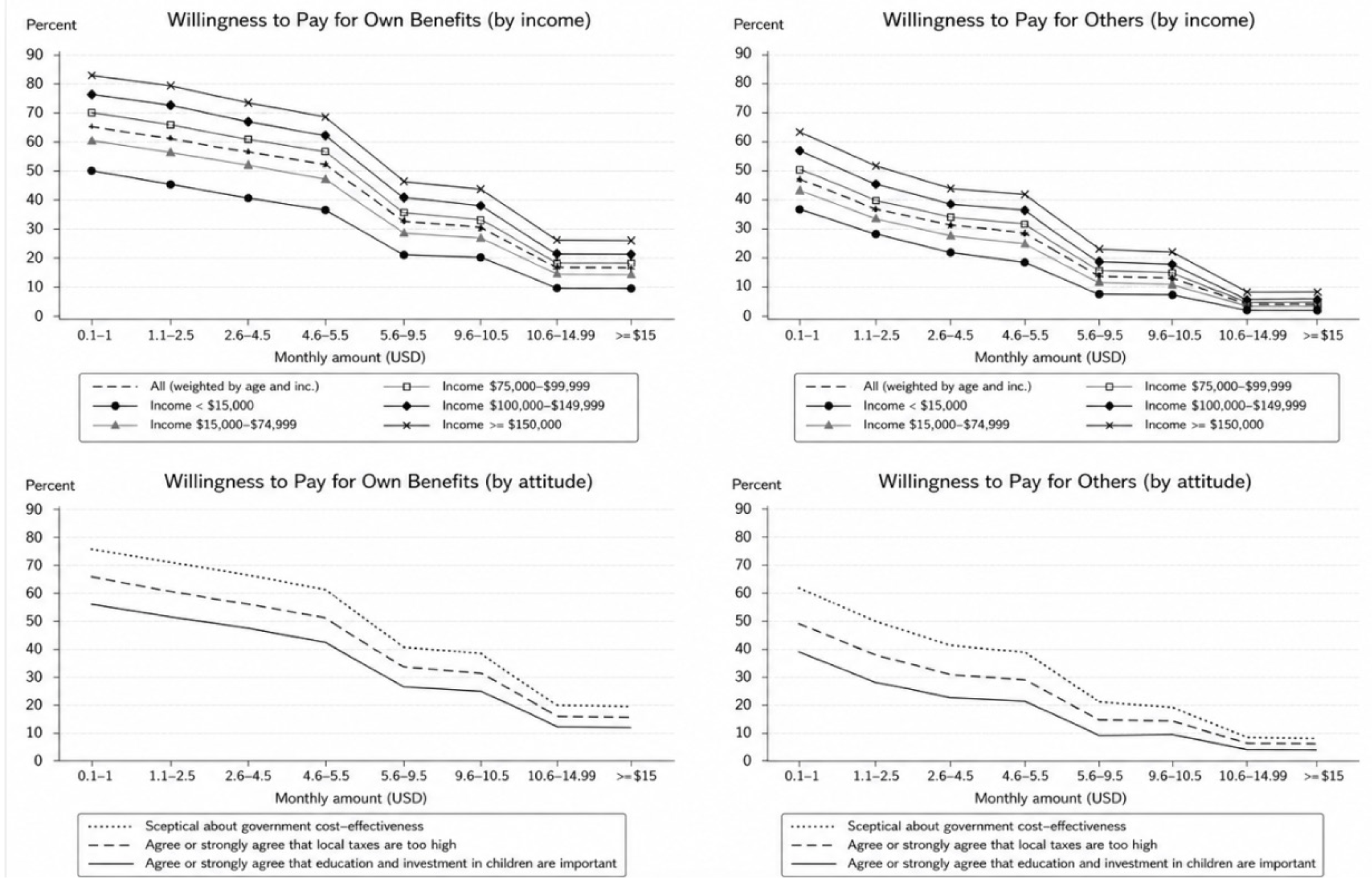
This income gradient appears for both private-use valuation and valuation of access for others. The similarity of the gradients across Fig. 2 suggests that the ability to pay conditions not only how respondents value their own use of library services, but also how willing they are to support universal access. As a result, aggregate WTP estimates implicitly weight higher-income respondents more heavily, even when median values are used. This has direct implications for county-level valuation: aggregate CV figures show the income distribution of respondents as much as the perceived benefits of library services.
Fig. 2 further show that stated valuation is structured by normative and fiscal beliefs rather than by service consumption alone. Respondents who assign greater importance to education and investment in children consistently report higher WTP across categories, for both personal use and others’ access. In contrast, respondents who agree with statements indicating skepticism about government effectiveness or concern that local taxes are already too high cluster in the lowest WTP categories, including zero WTP. These belief-based differences persist even among respondents who report similar patterns of library use, indicating that stated valuation present attitudes toward public provision rather than marginal service experience.
The fig. 2 show that CV responses embed multiple layers of interpretation. WTP does seem to be affected by respondents’ fiscal preferences, normative commitments to redistribution, and expectations about the appropriate role of local government. This explains why the CV-only aggregate estimate is substantially lower than the market-equivalent valuation of direct services. The gap does not necessarily indicate overvaluation in the market-based component; instead, it shows the fact that respondents may undervalue services that they perceive as discretionary, substitutable through private markets, or already adequately funded through taxes.
For this reason, the integrated ROI framework uses the “WTP for others” responses to estimate diffused social benefits separately, yielding an estimated USD 6.8 million. This figure captures support for universal access and collective benefit without conflating it with private-use valuation. More importantly, the figures show why this component cannot be interpreted independently of respondent characteristics: aggregate social-value estimates depend on who responds to the survey, their income position, and their beliefs about public finance.
Discussion
This study set out to examine whether an integrated valuation framework provides a more defensible basis for estimating the ROI of public libraries than reliance on a single methodological approach. ROI in non-market public services cannot be meaningfully reduced to one metric without obscuring how different value channels operate and interact (Irwin & St-Pierre, 2014). The contribution of the study lies less in the point estimate itself than in demonstrating how methodological choices affect what is counted as value and what is rendered invisible.
The evidence shows that stated-preference measures are systematically influenced by respondents’ socio-economic position and by their normative orientations toward public provision and taxation. WTP responses therefore show more than service benefit; they incorporate beliefs about the role of government, expectations about redistribution, and perceptions of fiscal burden. From a valuation perspective, this means that CV does not measure a neutral economic quantity, but a socially and politically mediated judgement. Interpreting such judgements as a proxy for economic value received risks conflating perceived legitimacy with actual resource substitution or cost avoidance (Diamond et al., 2010).
The integrated framework makes this limitation visible by placing survey-based valuation alongside market-equivalent estimates rather than allowing it to substitute for them. In doing so, the study reframes CV as a diagnostic tool rather than a definitive measure. Stated-preference results show how residents justify public funding and how support varies across population segments, but they are not well suited to anchoring budgetary decisions that require estimates of consumption-based value or replacement cost. This distinction is especially important in contexts where residents have high private purchasing capacity and therefore perceive public services as discretionary rather than infrastructural.
At the same time, our analysis cautions against treating market-equivalent valuation as a neutral or purely technical solution. Although the market-based component is more closely aligned with economic logic, it also depends on assumptions about substitution, usage, and pricing that are contestable. The study shows that conservative assumptions materially constrain estimated benefits, and that alternative but still defensible assumptions would produce substantially different outcomes. The methodological contribution here is not to claim that one set of assumptions is “correct,” but to show that market-based valuation allows those assumptions to be surfaced, interrogated, and revised. This transparency gives market-equivalent approaches a particular advantage in contested policy environments, where the credibility of an ROI estimate depends on whether its assumptions can be openly examined.
The divergence between perceived value and market-equivalent value raises an interpretive issue about how public services are evaluated. The findings suggest that residents may understate the value of services that function as collective infrastructure rather than as point-of-sale transactions. When services are available on demand, pooled across users, and embedded in long-term community capacity, their benefits are not always salient at the moment of valuation (Imholz & Arns, 2007). Survey responses may therefore present a consumer frame that emphasizes substitutability and individual use, even when the service generates value through risk pooling, option value, and shared access. This tension helps explain why perceived value may lag behind economic value in stated-preference measures, particularly for mature public institutions.
Public organisations increasingly perform hybrid functions that blur traditional boundaries between economic, social, educational, and civic domains. Public libraries provide a useful empirical setting precisely because they embody this institutional hybridity. Services such as digital literacy training, internet access, youth programmes, community meeting spaces, cultural programming, and advisory support frequently generate diffuse and indirect forms of value that cannot be reduced to market transactions alone. The study therefore does not assume that all dimensions of public value are fully monetisable. Rather, the integrated framework is intended to reduce the analytical distortion that occurs when evaluation systems privilege only those benefits that are easily priced or directly substitutable in private markets.
The model also carries implications for public sector accountability and performance management. In practice, governments and public organisations increasingly face pressure to justify expenditure decisions using quantifiable performance indicators and ROI metrics. However, single-method valuation models may unintentionally privilege particular conceptions of value while obscuring others. The framework proposed here suggests that valuation itself is not a purely technical exercise, but an administrative and political process involving decisions about visibility, legitimacy, and inclusion. By making assumptions explicit and separating different channels of value formation, the integrated approach provides a more transparent basis for policy discussion.
Conclusion
This study proposes an integrated framework for estimating public library ROI by combining market-equivalent valuation of direct user benefits, stated-preference valuation of diffused social benefits, and a net (not gross) local economic impact estimate. Applied to JCL, the integrated accounting yields an ROI of 313%, meaning that each local tax dollar is associated with more than four dollars in total benefits and a net return exceeding three dollars. The analytical contribution is not the production of a single headline ratio, but the use of multiple value channels to reduce dependence on any one method’s weakest assumptions and to make the evidentiary basis of an ROI claim more auditable across stakeholders.
The implication is largely methodological: ROI estimates for public libraries are sensitive to the valuation lens, and stated-preference measures can depart sharply from market-equivalent estimates even when both aim to represent “value”. In this case, the contingent-valuation-only aggregate (derived from the median WTP and extrapolated to the service population) is substantially smaller than the market-based direct-benefit estimate, consistent with longstanding concerns that WTP responses often embed limited information, symbolic support, and framing effects rather than the economic value actually received. The integrated approach therefore treats survey WTP as one input—informative about perceived legitimacy and social support, and about the distribution of valuation across demographic and attitudinal profiles—rather than as a stand-alone decision rule for resource allocation. More generally, the approach supports an interpretation of ROI as structured evidence for budgeting and service strategy: market-equivalent valuation is suited to replacement and cost-offset questions; survey-based valuation informs how residents interpret and justify public provision; and economic impact estimation addresses local retention and induced spending under conservative counterfactual assumptions.
Several limitations bound what can be claimed from this study and indicate priorities for future research. The analysis is a single-case application, so replication across counties with different income distributions, service mixes, and competitive ecosystems is required before making stronger general claims about the size of gaps between perceived and market-equivalent value. Also, each component depends on contestable assumptions (substitution choices, discounting rules, local retention shares, multiplier settings); while the framework makes these assumptions visible, future studies should formalize uncertainty with pre-specified sensitivity ranges and scenario tests rather than relying on point estimates. The survey-based component does not extrapolate to non-users; the paper notes that scaling beyond users could materially increase estimated diffused social benefits, so future work should incorporate population-based sampling that can separately estimate use, non-use, and option values while addressing protest responses and information effects. Our design is cross-sectional and associational: subsequent studies should pair valuation with stronger causal identification (for example, phased service expansions, branch refurbishments, or funding shocks) to estimate how marginal investments change usage, learning-related outcomes, digital access, and other policy-relevant endpoints. Because a substantial share of respondents regards private vendors as substitutes, future work should model substitutability explicitly (including switching costs and option value) and test how alternative “counterfactual service bundles” shift WTP and perceived substitutability under controlled information conditions.
Beyond its methodological contribution, the framework has implications for public administration practice. By disaggregating value into distinct components and making underlying assumptions explicit, the approach provides a structured basis for budget justification, performance evaluation, and strategic planning. It also allows policymakers to distinguish between consumption-based value, perceived legitimacy, and local economic impact, which are often conflated in single-metric analyses. In this sense, the integrated framework supports a more informed and transparent dialogue between analysts, decision-makers, and stakeholders regarding the value of public services.


